Weekday Warriors
The first rule of Run Club: you don't talk about Run Club

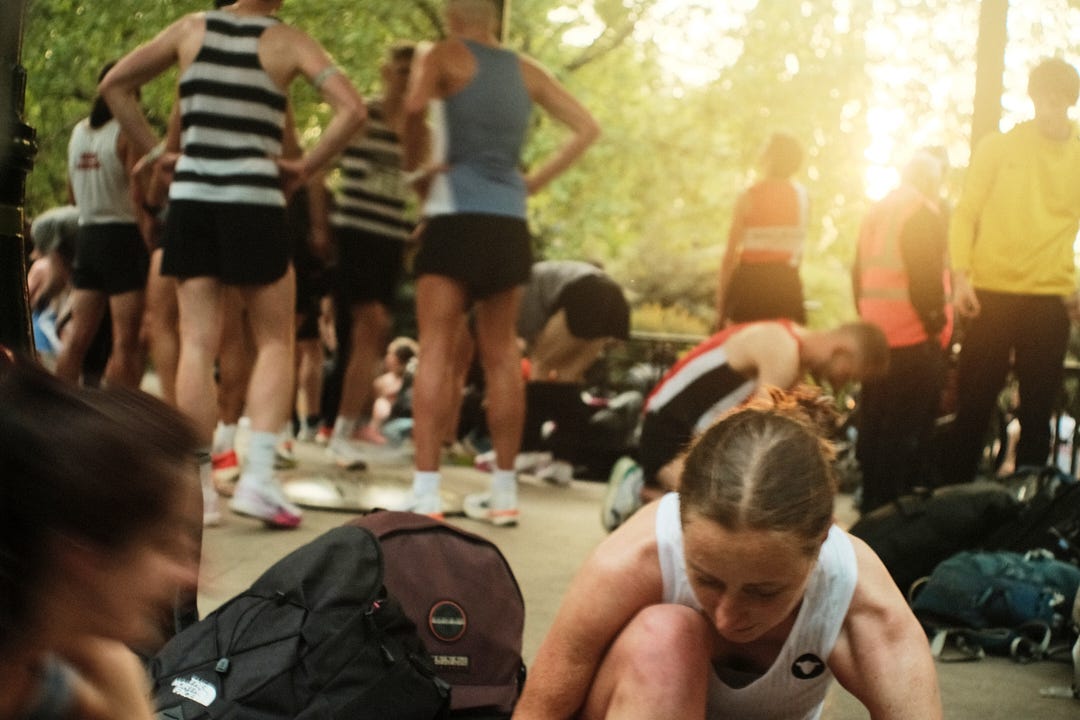
It’s a mild Friday evening in late April. I’m standing in Battersea Park looking for signs of life by the bandstand. Runners begin to flit around me in increasing numbers. This is a good sign; after all, I’m here to watch a running race. I gaze fondly as the spindly competitors begin to go through their warm-up routines, each as idiosyncratic as the next. When I was racing, I used to love this part: dynamic stretches, drills, strides. In a funny way, it was the closest I’ve ever come to dancing properly in my life — and probably the closest I ever will — such is the rhythm your legs find once they’ve warmed up and acclimated to the tempo of each skip variation or activation exercise.
The patter of trainers on tarmac casts my mind towards the weekend. This Sunday I’ll be on the streets of central London watching the London Marathon. Over 56,000 plod the city’s streets as participants on marathon day; it’s the world’s largest annual one-day fundraising event. The race folds through the capital from Greenwich to Westminster, a river of humanity snaking its way along the Thames in parts, crossing Tower Bridge, going out as far as the Isle of Dogs before turning back on itself to start the long run for home along the Embankment. Most of the 56,000 will run to raise funds and awareness for charitable causes. They may train for the race, but most compete to complete, not to place. For many, it's a race against oneself, and the prize is in the participation, the experience, the novelty medal and t-shirt.
None of anything I’ve just mentioned about the London Marathon can be applied to the race I am currently waiting to watch. The appropriately, though lengthily-named, Friday Night Under the Lights 5K (FNUL) is a true blue-collar, grassroots running road race. The frills and comforts associated with commercial, big-budget fun runs are nowhere to be found here. In Battersea, you turn up, run yourself into the ground, and go home. £20 and a fast-enough personal best gets you entry. There is no medal waiting for competitors at the finish, no flapjack or novelty running vest. The sole aim is to turn up and run bloody fast. Fields are limited to 60 runners per wave, of which there are usually three: two initial packs released a minute apart to help ease congestion, and the final, elite race. Winning times are routinely the quick side of 14 minutes and 30 seconds; the course record currently stands at 13:36.
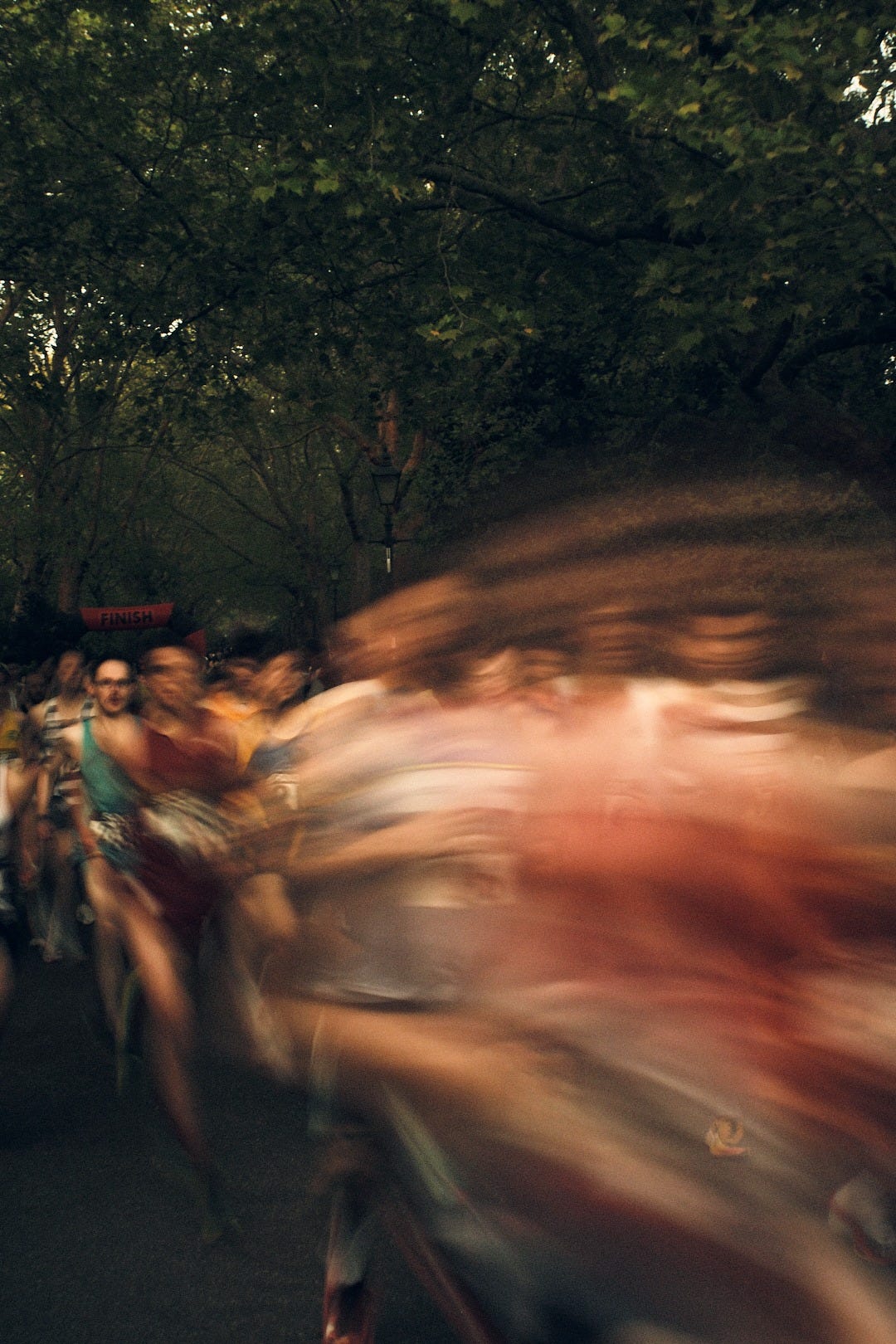
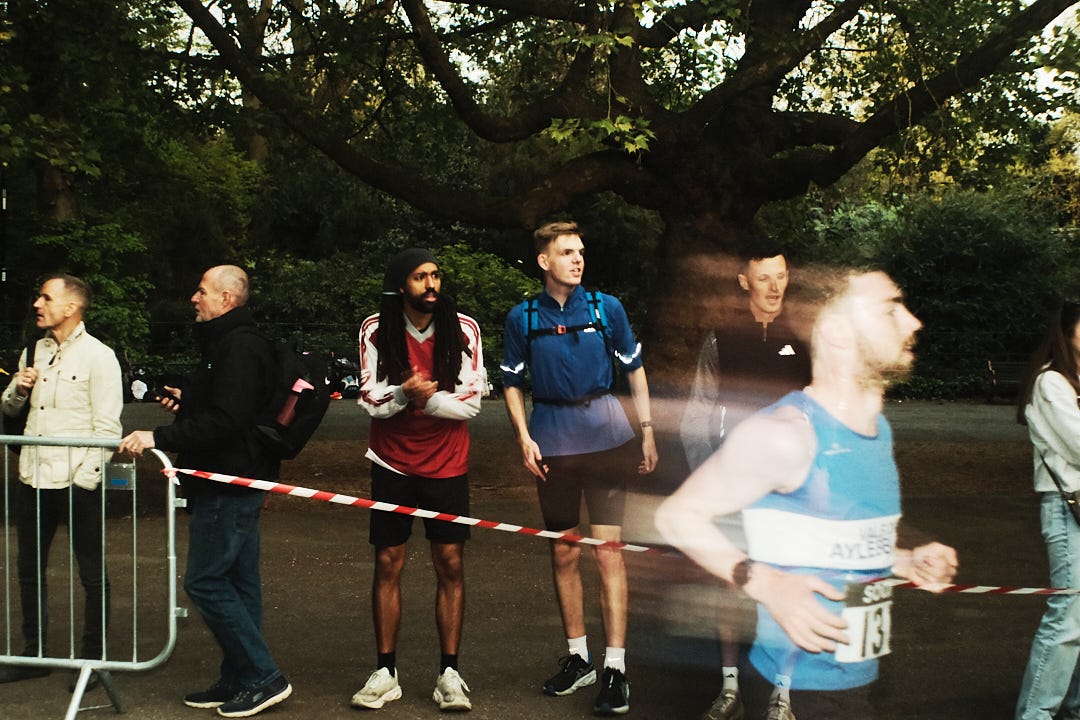
It’s seven o’clock. I position myself and begin to take photographs as the runners in the first wave take off. They roar through the park, cutting through final rays of sunlight which fall through the trees. What little pedestrian traffic the runners might have had to deal with has dissipated. People stand to the side and watch the herd fly past. The course is two laps, so I know that I’ll see the runners again very soon if I stay near the start line. Sure enough, the first wave of men and women hurtle past me. Shouts of encouragement rain down from the few but vocal spectators. You don’t typically come down to watch one of these races if you’re not a hardcore runner yourself.
The first race is won in 14:23 by a full-time veterinary surgeon. Back at the bandstand, flushed, tired bodies are strewn across benches and steps. People stagger aimlessly, oxygen-deprived and feeling it. Despite the agony, smiles reign. Those who had just spent the past fourteen minutes running each other into the ground couldn’t be more chuffed with themselves. And for good reason: the times are quick. Lots of people run personal bests in these races because they are so well-tailored for running fast. Many racers will implore their colleagues to care about the time they ran tonight in the office on Monday; many won’t succeed.
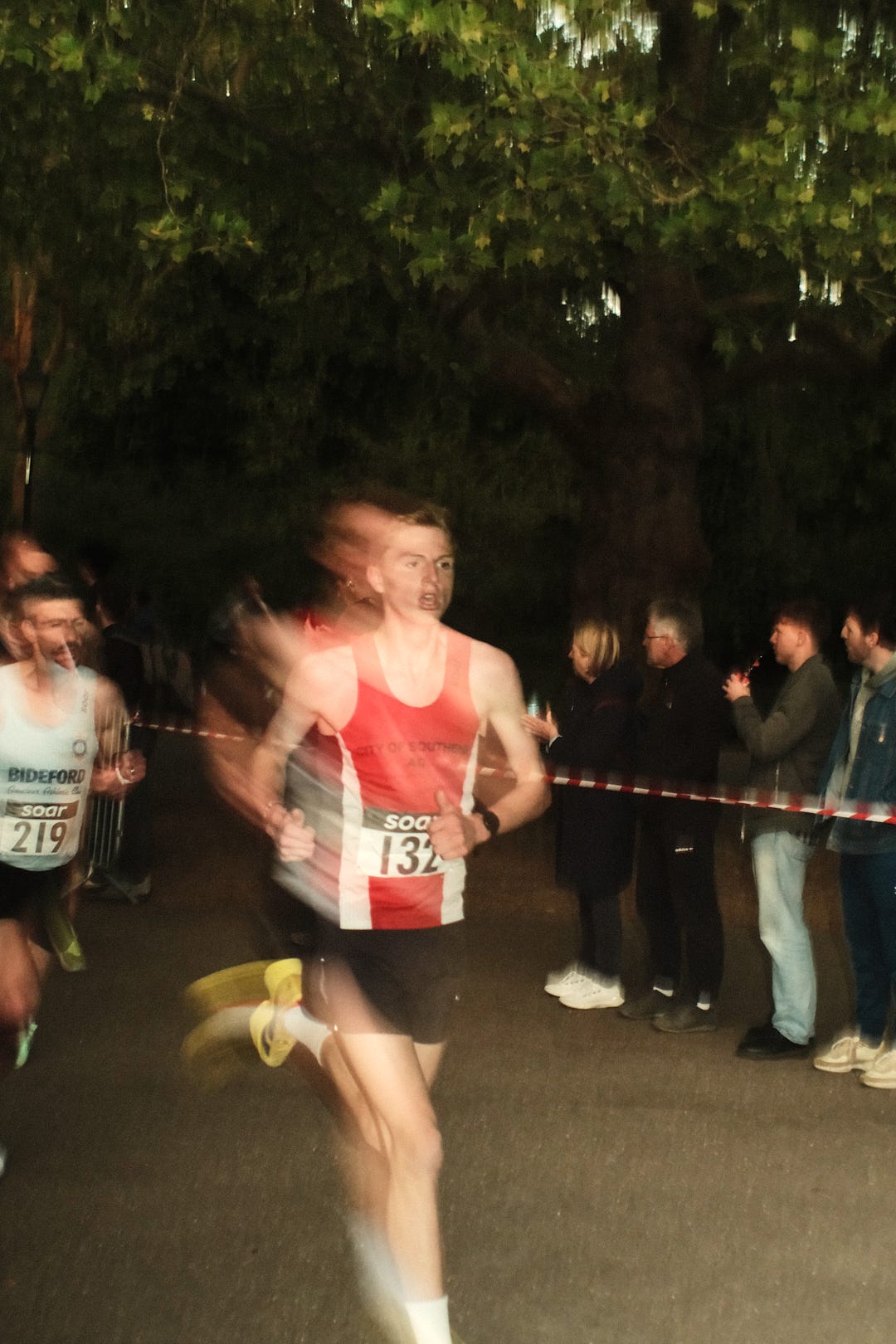
After twenty minutes, the elite wave — the fastest-seeded entrants — are fired down the straightaway by the starter’s whistle. These are the runners who, but for twenty seconds, might otherwise be running fast enough to make the sport their profession. They’re sub-elites, day-jobbers who juggle occupations with an incredible commitment to running as they strive to make up those stubborn half-minutes which separate them from professional-level performance. As they near my position, I step back, readying my camera. Watching them approach, I smile to myself. To me, this is what running is all about: the graft, the sheer simplicity, the high performance. Turn up, run fast, go [to the pub/home]. I grew up competing at a decently high level. I loved running and I loved racing, but the sport was on its knees. In many ways, run clubs, commercial fun runs, and running influencing have provided a lifeline by attracting the next generation of interest and capital. That being said, I am glad to see that the running I grew up with is still alive and well in South West London
.
The elite race is won in 14:07. I catch up with the winner, a quietly spoken bloke, Charlie. He seems fairly happy with his effort, but I get the sense he could go again if anyone asked him to. I congratulate him and ask if I can take his portrait on my MBP 4x5 large format camera. He nods with a smile. Runners are like that — friendly. By now the crowd of finished athletes has swollen significantly, and we attract some bemused looks from other runners as I go under my cape and have him stand in while I compose the image on the glass plate of the camera. Once the photograph is taken, I thank Charlie and send him off to get changed. He trots off towards his bag like the effort he just made was a warm-up. I also thank the race director, Keith, who helped me pluck Charlie from the throng of exhausted bodies at the finish. Keith is curious about my photography and naturally asks me to tag the race’s Instagram if ever I post any of my pictures from tonight. Of course, I agree. The event can use all the exposure it can get. Major running-events companies such as RunThrough UK boast nearly one hundred thousand Instagram followers; FNUL, on the other hand, has two thousand.
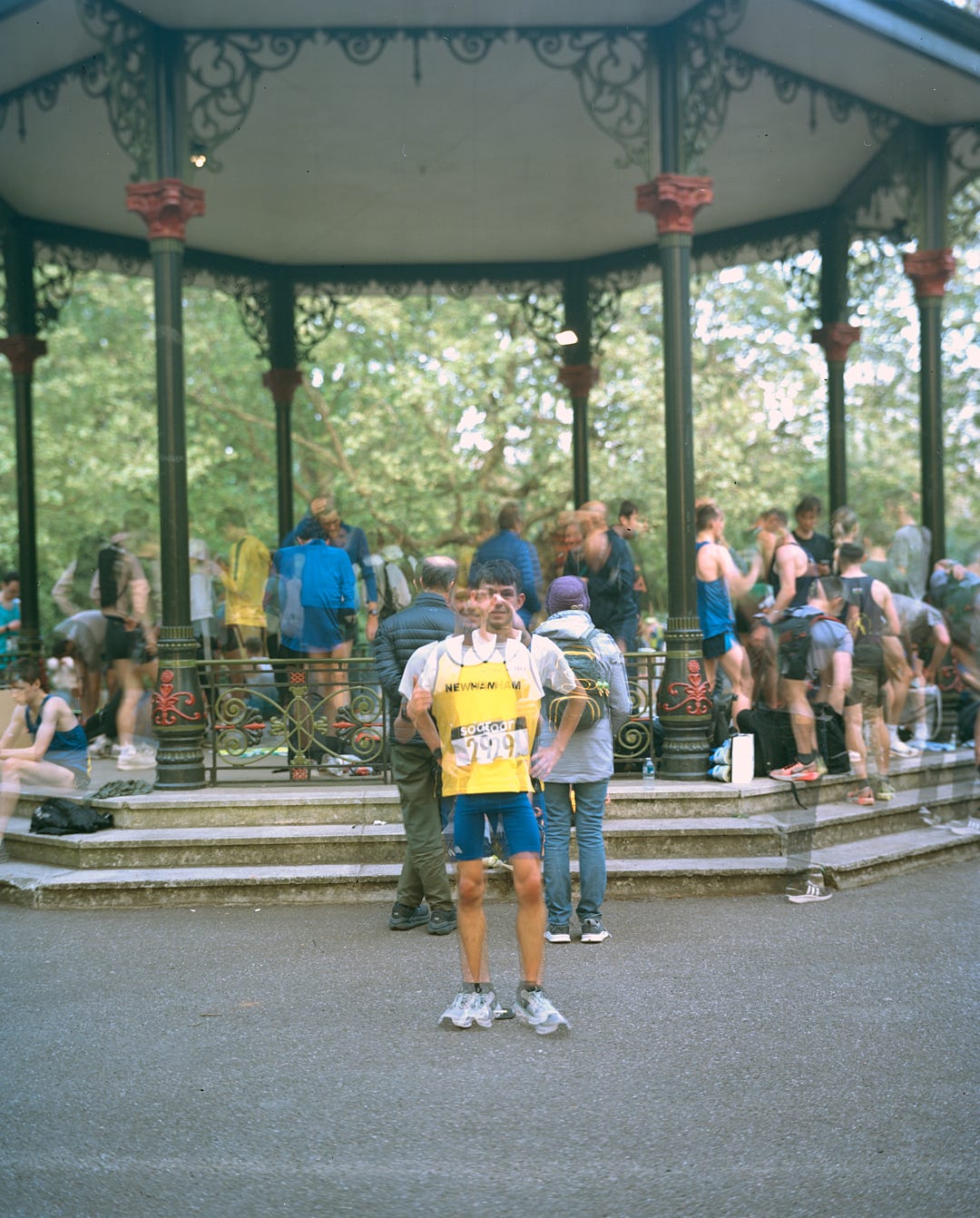
Running is back in vogue thanks to its conduciveness to social interaction. Run clubs have found a strong niche by posing the act of running as a space within which participants can meet socially. This perception of the sport as a conduit for social interaction has, as I’ve already touched on, welcomed a vast new generation to the fold — of course a great thing. Nonetheless, in my opinion, it is important to support the FNULs of the world, as they are the ones keeping the competitive side of the sport from falling away. I love the London Marathon’s of the running world; the size, the inclusivity, the non competitiveness. But I prefer the ferociousness and simplicity of FNUL. In an increasingly open and accessible age for the sport of running, let's not forget that a healthy dose of pure, grass-roots, sweat-soaked competition does nothing but good. Lets celebrate those individuals and small organisations who put their time and money aside to uphold this end of the sport.